
Keywords
Topological Reflection
Topological Approach
Culture
Intelligence
Superintelligence
Machine Intelligence
AI
Sherlock Holmes
Dr. House
How to Cite
Abstract
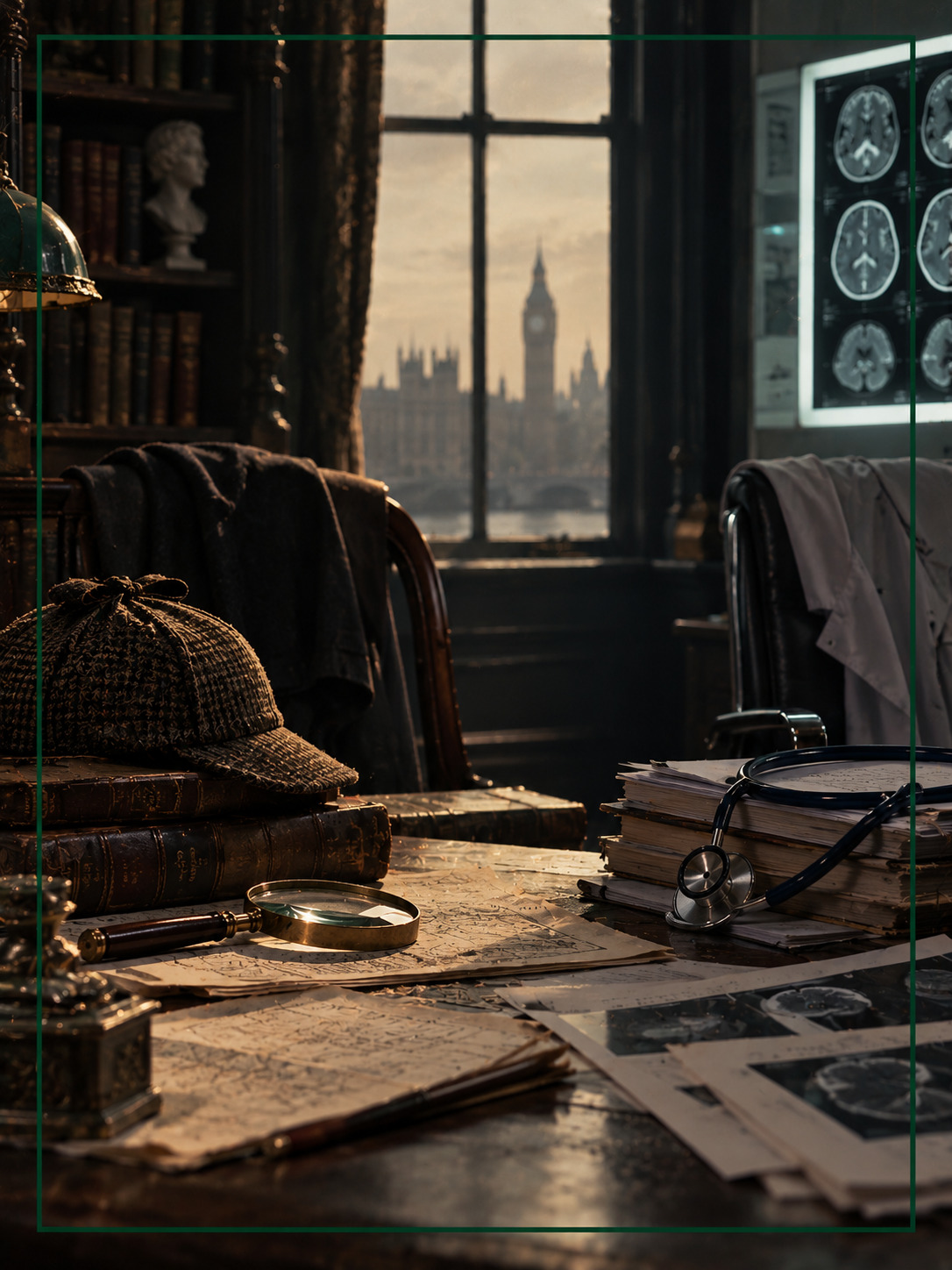
Topological reflection is an analytical method through which the author analyzes how culture can preserve itself while simultaneously being renewed. It concerns the formation of what is proper to culture. The author draws on V. V. Savchuk's work and further develops several lines of Savchuk's research. The object of the study is the coupling and competition between human and machine intelligence. Its subject is the Topos of Superintelligence. The author examines the image of Sherlock Holmes as a variant of the Superintelligence Topos. The discussion considers the formation of this topos in the era of neo-Romanticism, its ontological foundations, and its connection to the principle of Zadigism. The discussion then turns to the series “Sherlock” and “Dr. House” and demonstrates that the Topos of Superintelligence has changed because, in the contemporary context, machine intelligence no longer provides a basis for Romantic productivity. In other forms of the detective genre in the early twentieth century, an image of reality emerged that did not resonate with the culture of its time but gained attention in the early twenty-first century. This image becomes the ontological basis for the transformation of the Topos of Superintelligence. The author concludes that the unconscious of culture is shifting the strategy for developing intelligence toward specifically human competencies.
References
Aquinas, T. (2003). Summa Theologiae. Part I: Questions 44–74. Elga; Nika-Tsentr; Elkor-MK; Ekslibris. (In Russian).
Azarenko, S. A. (2016). Topological Philosophizing and Social Communication. Izvestiya of Saratov University. Philosophy. Psychology. Pedagogy, 16(4), 412–417. https://doi.org/10.18500/1819-7671-2016-16-4-412-417 (In Russian).
Bibikhin, V. V. (2012). Property: The Philosophy of One’s Own. Nauka. (In Russian).
Doyle, A. C. (1990). Something about Sherlock Holmes. In A. Stroev (Comp.), How to Make a Detective Story (pp. 3–15). Raduga. (In Russian).
Doyle, A. C. (2019). The Complete works on Sherlock Holmes in One Volume. Alfa-kniga. (In Russian).
Filyushkina, S. N. (2012). The Detective Story and the Problem of Cultural Memory: Attacks of Innovation and the Stubbornness of Genre. Nauka-Yunipress. (In Russian).
Leonova, E. A. (2010). German Literature of the Twentieth Century: Germany, Austria. Flinta; Nauka. (In Russian).
Linkov, S. V. (2023). Film as a Media Product: Semiotic and Discursive Approaches to Definition. Mediasreda, (1), 61–64. (In Russian).
Makhov, A. E. (2001). Topos. In A. N. Nikolyukin (Ed.), Literary Encyclopedia of Terms and Concepts (p. 1076). Intelvak. (In Russian).
Mandelbrot, B. B. (2004). Fractals, Chance, and Finance. NITs “Regulyarnaya i khaoticheskaya dinamika.” (In Russian).
Mishchenko, E. (2017). More Conservative than Holmes Himself: A Scientific Analysis of the Series Sherlock. Indicator. https://indicator.ru/humanitarian-science/sherlok-serial.htm (In Russian).
Moffat, S., & Gattis, M. (Directors). (2010). Sherlock [Video recording]. Hartswood Films; BBC Productions.
Plevako, S. V. (2013). Poetics of the Television Series House M.D. (USA, 2004–2012): Narrative, Mythology, Pragmatics. Uchenye zapiski ZabGU. Seriya: Filologiya, istoriya, vostokovedenie, (2), 196–204. (In Russian).
Rushkoff, D. (2003). Media Virus!: Hidden Agendas in Popular Culture. Ultra.Kultura. (In Russian).
Savchuk, V. V. (2012a). Topological Reflection. Political Conceptology, (4), 174–305. (In Russian).
Savchuk, V. V. (2012b). Topological Reflection. Kanon+ ROOI “Reabilitatsiya.” (In Russian).
Sayers, D. L. (1929, August 3). A Sport of Noble Minds. The Saturday Review of Literature, 22–23.
Shilov, V. V. (2004). The History of Logical Machines. Informatsionnye Tekhnologii, (6). https://nsu.ru/xmlui/bitstream/handle/nsu/9043/shilov.pdf?sequence=1 (In Russian).
Shore, D. (Director). (2004). House M.D. [Video recording]. Heel and Toe Films; Shore Z Productions; Bad Hat Productions; Universal Television.
Stepanov, V. (2011, January 19). Once Upon a Time There was a Doctor. Seans. https://seance.ru/articles/zhil-byil-doktor/ (In Russian).
Stirner, M. (1994). The ego and its own. Osnova. (In Russian).
Tolmachev, V. M. (2001). Neo-Romanticism. In A. N. Nikolyukin (Ed.), Literary Encyclopedia of Terms and Concepts (pp. 640–646). Intelvak. (In Russian).
Urnov, M. (1986). Conan Doyle, Sherlock Holmes, and Professor Challenger. In A. C. Doyle, The lost world: Fantastic works (pp. 493–514). Pravda. (In Russian).
Ushkin, S. G. (2019). Mikhail Bakhtin and Contemporary Actor-Network Theory. Sotsialnye normy I praktiki, (1), 50–63. (In Russian).
Vareshin, N. V. (2020). The Evolution of the Image of the Private Detective in A. C. Doyle’s Prose. Philology. Theory & Practice, 13(5), 87–93. https://doi.org/10.30853/filnauki.2020.5.17 (In Russian).

This work is licensed under a Creative Commons Attribution 4.0 International License.
Copyright (c) 2026 Svetlana V. Obolkina