
Keywords
Crossover
Nostalgia
Soviet Culture
Intermediality
Adaptation
Children's Media
Voice of a Friend
TV Adaptation
Media Philosophy
How to Cite
Abstract
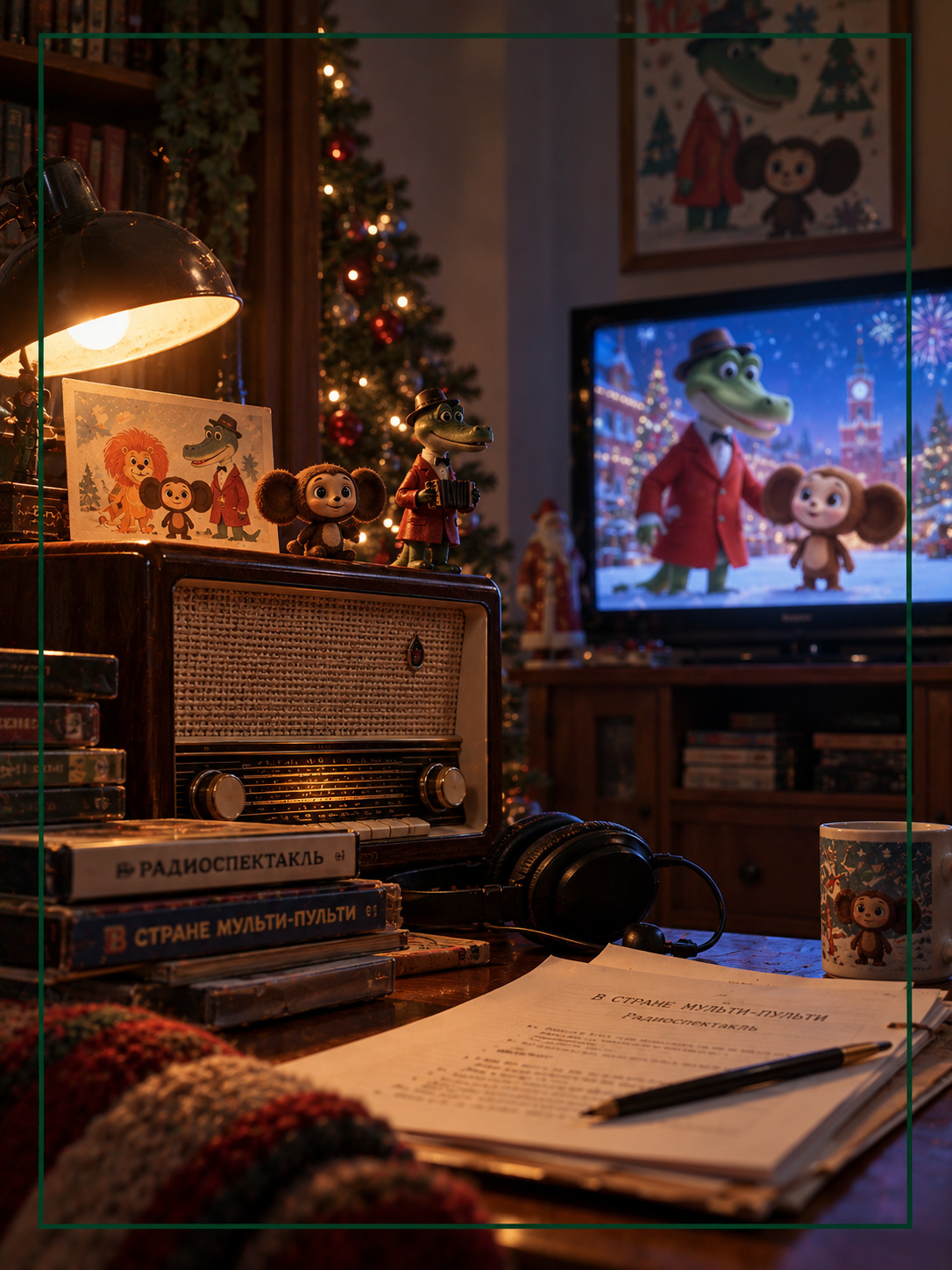
The 2022 television adaptation of the Soviet radio play An Incident in the Land of Multi-Pulti was met with significant criticism and a generally poor reception. This outcome raises questions about the challenges posed by intermedial translation and shifting cultural contexts, as well as about the loss of key elements that made the original radio play successful. The study investigates why the adaptation failed to resonate with contemporary audiences despite its nostalgic appeal. Specifically, it identifies the factors contributing to the adaptation’s failure, focusing on media-specific, cultural, and narrative discrepancies between the original radio play and its televised version. The analysis reveals that the adaptation struggled due to a mismatch with the conventions of New Year’s television programming, an inadequate visual reinterpretation of an audio-based narrative, and a disconnect between Soviet collectivist themes and contemporary individualistic media culture. Additionally, the shift from dynamic vocal performances to static visuals diminished the imaginative engagement fostered by the original. The study concludes that successful adaptations of Soviet-era children’s media require careful consideration of intermedial translation and cultural context. The 2022 version ultimately failed because it prioritized nostalgia over the original’s collective empathy and vocal artistry, highlighting the importance of preserving core imaginative elements in cross-media adaptations.
References
Alarm Clock: The Wolf and the Seven Young Goats [Video recording]. (1977). https://vk.com/video-45622701_456241736 (In Russian).
Boym, S. (1995). From the Russian Soul to Post-Communist Nostalgia. Representations, 49, 133–166. https://doi.org/10.2307/2928753
Chukovsky, K. I. (2001). From Two to Five. In Collected Works in Fifteen Volumes (Vol. 2, p. 638). Terra‑Knizhnyi klub. (In Russian).
Davydov, D. M. (2025). The Naïve Author as a (Non-)Graphomaniac: Toward the Problem of the Correlation of Concepts. New Literary Observer, (3), 263–286. https://doi.org/10.53953/08696365_2025_193_3_263 (In Russian).
Fédier, F. (2018). The Voice of the Friend (2nd rev. ed.; O. A. Sedakova, Trans.). Izdatelstvo Ivana Limbakha. (In Russian).
Ganzha, A. G. (2008). Client or Patient? Production and Consumption of Knowledge in the Health Industry. Politicheskii zhurnal, (2[179]), 81–83. (In Russian).
Goffman, E. (2003). Frame Analysis: An Essay on the Organization of Everyday Experience (G. S. Batygin & L. A. Kozlova, Eds.). Institut sotsiologii RAN. (In Russian).
Kaspe, I. M. (2017). “I exist!”: Late Soviet Cinema Through the Lens of Harrison White’s Relational Sociology (Et Vice Versa). Russian Sociological Review, 16(3), 174–206. https://doi.org/10.17323/1728-192X-2017-3-174-206 (In Russian).
Levchenko, Ya. (Ed.). (2023). Man with a Diamond Arm: On the Centenary of Leonid Gaidai. Novoe literaturnoe obozrenie. (In Russian).
Levenbuk, A., & Khait, A. (1981). An Incident in the Land of Multi-Pulti [Audio recording]. http://staroeradio.ru/audio/14437 (In Russian).
Levenbuk, A., & Khait, A. (2022). An Incident in the Land of Multi-Pulti [Video recording]. https://vk.com/video-140070739_456241212 (In Russian).
Litovskaya, M. (2013). Radio Nanny, or What is Funny about a Kangaroo. Russian Literature, 74(1–2), 141–162. https://doi.org/10.1016/j.ruslit.2013.10.007 (In Russian).
Lotman, Yu. M. (1992). The Phenomenon of Culture. In Selected Articles in Three Volumes (Vol. 1, pp. 34–45). Aleksandra. (In Russian).
Lovell, S. (2011). How Russia Learned to Listen: Radio and the Making of Soviet Culture. Kritika: Explorations in Russian and Eurasian History, 12(3), 591–615. https://doi.org/10.1353/kri.2011.0040
Lovell, S. (2013). Broadcasting Bolshevik: The Radio Voice of Soviet Culture, 1920s–1950s. Journal of Contemporary History, 48(1), 78–97. https://doi.org/10.1177/0022009412461817
McLuhan, M. (2003). Understanding Media: The Extensions of Man. KANON-press-Ts; Kuchkovo pole. (In Russian).
Orlova, G. A. (2009). “A Journey in Absentia”: Managing the Geographical Imagination in the Stalinist Era. New Literary Observer, (100), 266–285. (In Russian).
Orlova, G. A. (2017). Bakhtin in Different Voices: Ethnographic Studies on Intonation. Practices & Interpretations: A Journal of Philology, Teaching and Cultural Studies, 2(4), 46–57. (In Russian).
Pluzhnik, V. V. (2019). The Radio Voice as a Regime of Intermediality in Soviet Culture. RSUH/RGGU Bulletin. “Literary Theory. Linguistics. Cultural Studies” Series, (8), 149–160. https://doi.org/10.28995/2686-7249-2019-8-149-160 (In Russian).
Pluzhnik, V. V. (2021). Voice, Text, and Image in Late Soviet Documentary Cinema: Mikhail Romm’s film And Yet I Believe... Articult, (1), 68–79. https://doi.org/10.28995/2227-6165-2021-1-68-79 (In Russian).
Radio Nanny. Episode 108 [Video recording]. (1980). https://vk.com/video-60958526_456279852 (In Russian).
Savchuk, V. V. (2013). Media Philosophy: The Attack of Reality. RKhGA. (In Russian).
Shannon, C. E. (1948). A Mathematical Theory of Communication. Bell System Technical Journal, 27(3), 379–423. https://doi.org/10.1002/j.1538-7305.1948.tb01338.x
Shukshin, V. M. (1972, October 27). How the Little Hare Flew on Balloons. Literaturnaya Rossiya, (44). (In Russian).
Sirotinina, S. S., & Kelly, C. (2008). “It was Incomprehensible and Funny”: Holidays in the last Decades of Soviet Power and their Perception by Children. Forum for Anthropology and Culture, (8), 258–299. (In Russian).
Zhurkova, D. A. (2021). “Old Songs about the Main Things”: An Alternative Anthology of Soviet Popular Music. New Literary Observer, (3[169]), 148–164. (In Russian).
Zielinski, S. (2019). Media Archaeology: On the “Deep Time” of Audiovisual Technologies (B. Skuratov, Trans.). Ad Marginem Press; Garage Museum of Contemporary Art. (In Russian).

This work is licensed under a Creative Commons Attribution 4.0 International License.
Copyright (c) 2026 Alexander V. Markov, Oksana A. Shtayn