
Keywords
Posthuman
Transhuman
Space Marines
Adeptus Astartes
Warhammer 40 000
Human
Humanism
Übermensch
Transhuman Space
How to Cite
Abstract
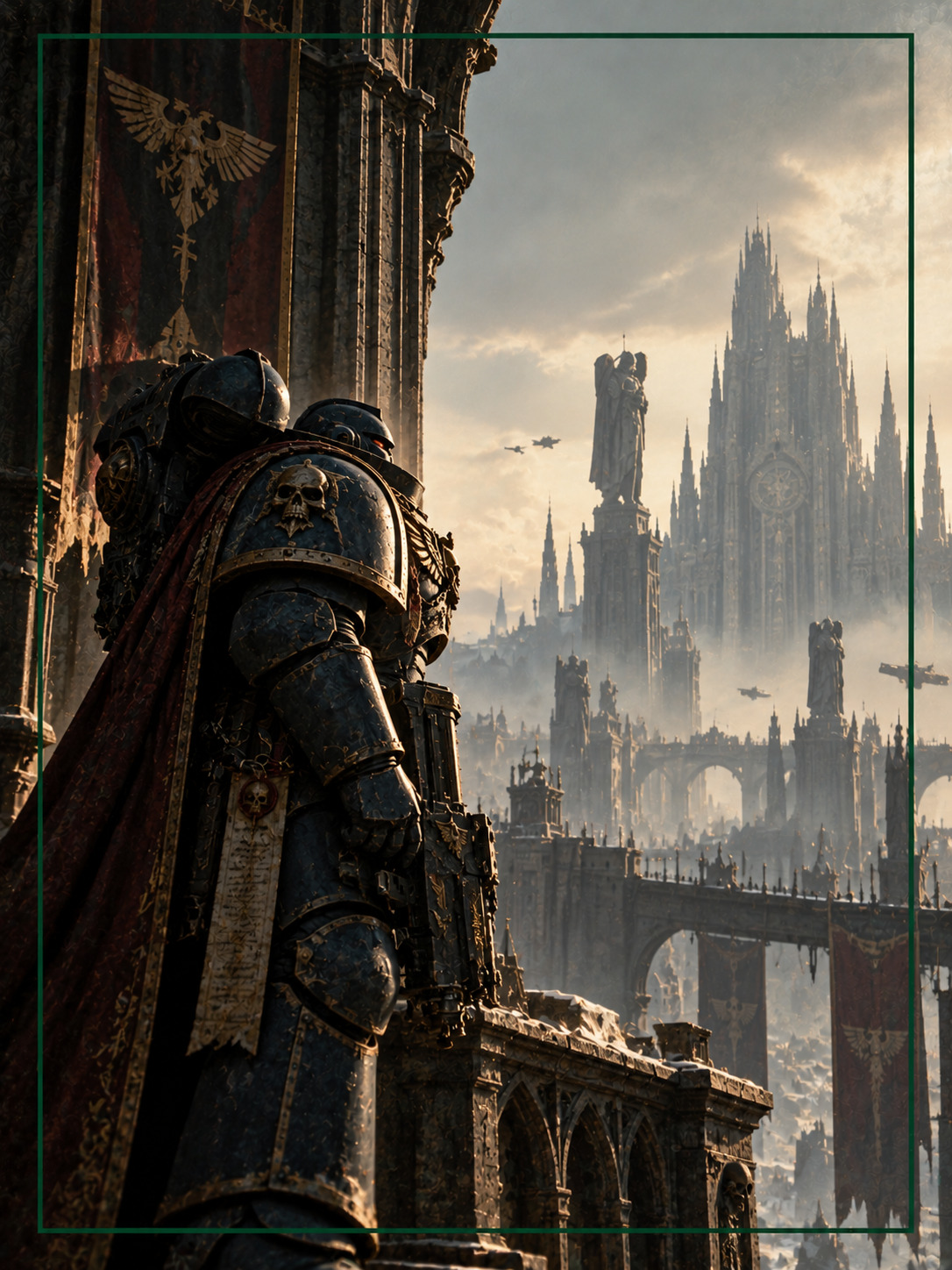
The article examines the ideal of the transhuman in the Warhammer 40,000 (WH40K) universe, as embodied by the Space Marines (Adeptus Astartes), one manifestation of the author's broader concept of transhuman space. The image of the Adeptus Astartes as transhuman is problematized, and the concepts of “posthuman” and “human” within WH40K fandom are also examined. To achieve this aim, the study pursues the following objectives: (1) to define the concepts of “human,” “transhuman,” “posthuman,” and “transhumanism”; (2) to investigate the nature of the transhuman Space Marines in the WH40K space-opera universe; (3) to draw conclusions regarding the continuity between contemporary humans and the WH40K transhuman.
To this end, comparative and critical approaches are employed. The WH40K fandom’s conception of the transhuman is examined through the lens of transhumanist philosophy. Transhumanism is a philosophy, worldview, and international movement that advocates advancing human evolution through science and technology, as well as overcoming the four certainties of human existence: suffering, disease, senility, and death. The transhuman Space Marine is examined with respect to his augmentations, implants, and interfaces. The transhuman is positioned as an intermediate stage in the transition from human to posthuman.
The article presents the results of a pilot sociological survey incorporating elements of in-depth interviewing and involving fans of the Warhammer 40,000 universe. The study concludes that the WH40K transhuman does not correspond to the “spirit and letter” of transhumanism for three reasons: (a) it implies the emergence of a new form of social inequality; (b) it represents a militaristic model that is inapplicable in peacetime; (c) it excludes women from consideration.
References
Bostrom, N. (2005). A History of Transhumanist Thought. Journal of Evolution and Technology, 14(1).
Braidotti, R. (2013). The Posthuman. Polity Press.
Dennett, D. C. (1988). Conditions of Personhood. In M. F. Goodman (Ed.), What is a Person? (pp. 145‑167). Humana Press..
Dialectics. (1983). In L. F. Ilyichev, P. N. Fedoseev, S. M. Kovalev, & V. G. Panov (Eds.), Philosophical Encyclopedic Dictionary (pp. 154–158). Sovetskaya Entsiklopediya. (In Russian).
Drexler, E. (1992). Nanosystems: Molecular Machinery, Manufacturing, and Computation. John Wiley & Sons.
Fedirko, M. V. (2020). The Specificity of the Dark Fantasy Genre. In Formation of the Professional Competence of a Philologist in a Multicultural Educational Environment: Proceedings of the III International Scientific and Practical Conference (pp. 280–283). (In Russian).
Fedorov, N. F. (1982). Works. Mysl’. (In Russian).
Fukuyama, F. (2004). Our Posthuman Future: Consequences of the Biotechnology Revolution. AST. (In Russian).
Gagarin, A. S. (2023). Existing and Transcending: Philosophical Interpretations. Review of Omsk State Pedagogical University. Humanitarian Research, (1), 9–14. https://doi.org/10.36809/2309-9380-2023-38-9-14 (In Russian).
Galev, R. V., & Ivanchenko, M. A. (2024). Bracketing Death: How Culture Sustains the Fear of immortality. Chelovek.ru, (19), 182–195. https://doi.org/10.32691/2410-0935-2024-19-182-195 (In Russian).
Gornovskii, A. O. (2018). Quasi-Religion: The Imperial Cult in the Warhammer 40,000 universe (79–87). (In Russian).
Hayles, N. K. (2005). My Mother Was a Computer: Digital Subjects and Literary Texts. Chicago Press. https://doi.org/10.7208/chicago/9780226321493.001.0001
Herbrechter, S. (2013). Posthumanism. A Critical Analysis. Bloomsbury Academic.
Illarionov, G. A. (2021). Game Religions and Game Transcendences. In The Secular Age: Challenges of Civilization (pp. 28–33). (In Russian).
Ivanchenko, M. A. (2024). Primary and Secondary Suffering in Psychiatry, Oncology, Buddhism, Transhumanism, and the Necessity of Its Overcoming. Galactica Media: Journal of Media Studies, 6(1), 244–273. https://doi.org/10.46539/gmd.v6i1.399 (In Russian).
Karmanova, S. A. (2023). Features of the Fantasy Genre in R. F. Kuang’s Trilogy The Poppy War. Filologiya v XXI veke, (2), 33–40. (In Russian).
Kerimov, T. Kh. (2018). Renewing Humanism: Its Possibilities and Limits. Izvestia. Ural Federal University Journal. Series 3: Social Sciences, 13(3), 16–26. (In Russian).
Lipinskaya, A. A. (2017). Dan Abnett’s Pariah: Playing with the Victorian novel. In The literary text of the 20th–21st centuries: Problems of poetics: Proceedings of the VII–VIII International Scientific and Practical Conference (pp. 75–80). (In Russian).
Lyotard, J. F. (1991). The Inhuman: Reflections on Time. Polity Press.
McClain Brown, C. (2024). Towards a Generic Fascism: Right-Wing Totalitarian Aspects in the Universe of Warhammer 40,000. Politička Misao, 61(2), 29–51. https://doi.org/10.20901/pm.61.2.02
Pivovarov, D. V. (2006). Philosophy of Religion. Akademicheskii Proekt; Delovaya kniga. (In Russian).
Roden, D. (2015). Posthuman Life. Philosophy at the Edge of the Human. Routledge Taylor & Francis Group. https://doi.org/10.4324/9781315744506
Roden, R. (2020). Posthumanism: Critical, Speculative, Biomorphic. In M. R. Thomsen & J. Wamberg (Eds.), The Bloomsbury Handbook of Posthumanism (pp. 81–94). Bloomsbury. https://doi.org/10.5040/9781350090507.ch-007
Sazeeva, I. B., & Grosheva, T. N. (2017). The Antihumanist Character of the Philosophy of Transhumanism. Historical, Philosophical, Political and Law Sciences, Culturology and Study of Art. Issues of Theory and Practice, (3–1), 122–126. (In Russian).
Sidenkova, A. P., Myakotnykh, V. S., & Ivanchenko, M. A. (2023). Interpreting the Essence of Dementia in the Context of the Debate Between Humanism and Transhumanism. Voprosy Filosofii, (2), 68–78. https://doi.org/10.21146/0042-8744-2023-2-68-78 (In Russian).
Silantyev, R. A. (2016). Theological Modeling Through the Literature of the Warhammer 40,000 Setting. Vestnik of Moscow State Linguistic University. Humanities, (23), 138–146. (In Russian).
Stavtseva, O. I. (2023). Posthuman: A concept or an Event? Reflections on the Future of the Human of the Anthropocene. Pushkin Leningrad State University Journal, (1), 8–20. https://doi.org/10.35231/18186653_2023_1_8 (In Russian).
Thacker, E. (2005). The Global Genome: Biotechnology, Politics, and Culture. MIT Press.
Tsvetkov, E. V. (2008). Science Fiction and Scientific Foresight. Vestnik of Northern (Arctic) Federal University. Series: Humanitarian and Social Sciences, (1), 49–54. (In Russian).
Turchin, A. V., & Batin, M. A. (2013). Futurology. The 21st century: Immortality or Global Catastrophe? Binom. Laboratoriya znanii. (In Russian).
Van Creveld, M. (2013). Wargames From Gladiators to Gigabytes. Cambridge University Press. https://doi.org/10.1017/CBO9781139579872
Vasiliev, E. V. (2021). Interpretation of Lucifer’s Image and the History of the Fall of the Angels in Aaron Dembski-Bowden’s Novel The First Heretic. In Ancient Contexts: Disciplinary and Interdisciplinary strategies: A collective Monograph (pp. 423–432). Natsional’nyi issledovatel’skii Nizhegorodskii gosudarstvennyi universitet im. N. I. Lobachevskogo. (In Russian).
Vasiliev, E. V. (2023). Rethinking the Image of the Cultural Hero in the Warhammer 40,000 Setting: The Case of Chris Wraight’s Novel The Lords of Silence. In Romano-Germanic literatures: Traditions and modernity: Proceedings of the 1st International Scientific Conference (pp. 111–117). Izdatel’skii tsentr Belorusskogo gosudarstvennogo universiteta. (In Russian).
Vostretsov, E. Yu. (2016). The Problem of the Religious Studies Status of the Phenomenon of “Fictional Religions”. In Philosophical Problems of Religion, Morality, Politics, and Law: Proceedings of the All-Russian Scientific and Practical Conference (p. 121). (In Russian).
Wilson, S., & Haslam, N. (2009). Is the Future more or less Human? Differing Views of Humanness in the Posthumanism Debate. Journal for the Theory of Social Behaviour, 39(2), 247–266. https://doi.org/10.1111/j.1468-5914.2009.00398.x
Wolfe, C. (2010). What is Posthumanism? Minnesota University Press.
Zvirevich, V. T. (2004). Philosophy of the Ancient World and the Middle Ages. Akademicheskii Proekt. (In Russian).

This work is licensed under a Creative Commons Attribution 4.0 International License.
Copyright (c) 2026 Mariia A. Ivanchenko, Evgenii Yu. Vostretsov