
Ключевые слова
ранняя фотография
технологический шок
легитимация искусства
демократизация творчества
доверие к изображению
Как цитировать
Аннотация
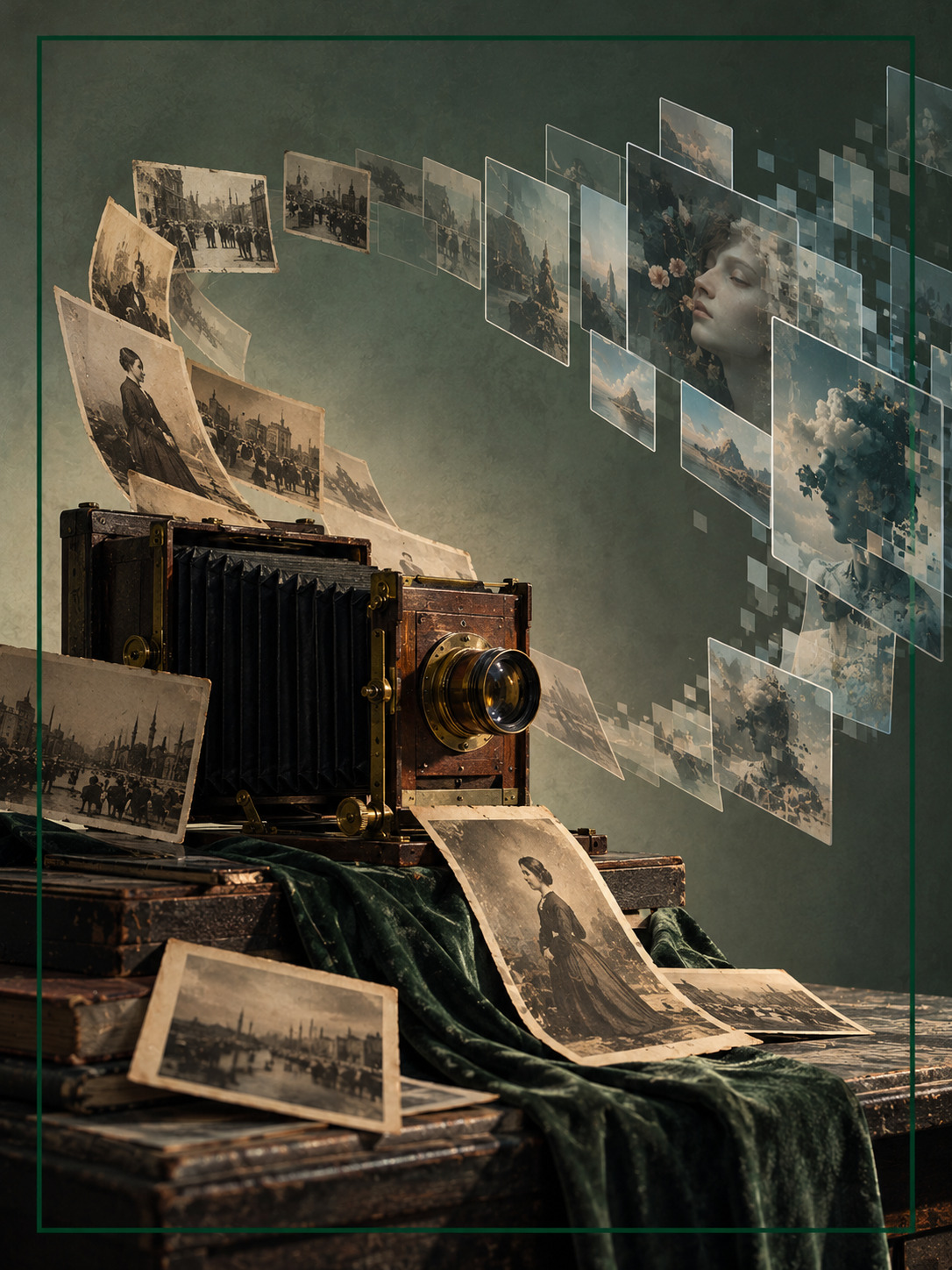
В статье анализируется цикличность культурных реакций на технологические сдвиги в сфере визуальности путём сопоставления современных дискуссий о генеративных медиа и исторических дебатов о ранней фотографии XIX века. В рамках концепции «технологического шока» (technoshock) показано, как инструменты массового производства изображений порождают повторяющиеся конфликты вокруг статуса изображения, критериев достоверности и ценности профессионального труда. В качестве аналитических категорий выделяются пять устойчивых «тревог»: (1) утверждение нового медиума как средства художественного выражения; (2) демократизация творчества и размывание границы «любитель/профессионал»; (3) страх вытеснения и обесценивания ремесла; (4) риск эстетической гомогенизации и снижения культурного разнообразия; (5) фальсификации и кризис доверия к изображению как свидетельству.
Методологическую основу статьи составляет медиаархеологическое сопоставление: современные тревоги, связанные с распространением генеративного ИИ, анализируются в соотнесении с разнородным корпусом критических, экспертных и историко-теоретических текстов о фотографии XIX – начала XX века, включая позднейшие научные реконструкции этого периода. Исследование демонстрирует, что значительная часть сегодняшних опасений имеет исторические аналоги, а их воспроизведение связано с борьбой за нормы «легитимного изображения» в условиях ускорения, удешевления и массовизации визуального производства.
Библиографические ссылки
Anonymous. (1980). Is Photography a New Art. In A. Trachtenberg (Ed.), Classic essays on photography (pp. 133–140). Leete’s Island Books.
Arago, F. (1980). Report. In A. Trachtenberg (Ed.), Classic essays on photography (pp. 15-25). Leete’s Island Books.
Azoulay, A. (2018, October 31). Unlearning Decisive Moments of Photography. Fotomuseum Winterthur. https://www.fotomuseum.ch/en/series/unlearning-decisive-moments-of-photography/
Baudelaire, C. (1980). The Modern Public and Photography. In A. Trachtenberg (Ed.), Classic essays on photography (pp. 83-89). Leete’s Island Books.
Bown, N. (1996). ‘There are Fairies at the Bottom of Our Garden’: Fairies, Fantasy and Photography. Textual Practice, 10(1), 57–82. https://doi.org/10.1080/09502369608582239
De Zayas, M. (1980). Photography and Artistic Photography. In A. Trachtenberg (Ed.), Classic essays on photography (pp. 125–132). Leete’s Island Books.
Denisova, V. A. (2025). Transformation of the Visual Arts Field in the Context of the Development of Generative Artificial Intelligence (Based on Interviews With Russian Artists). Telescope: Journal of Sociological and Marketing Research, (3), 126–133. https://doi.org/10.24412/1994-3776-2025-3-126-133 (In Russian).
Doyle, A. C. (1920). Fairies Photographed: An Epoch-Making Event. The Strand Magazine, 60(360), 463‑468.
Doyle, A. C. (1922). The Coming of the Fairies. Hodder & Stoughton.
Fawcett, T. (1986). Graphic Versus Photographic in the Nineteenth‐Century Reproduction. Art History, 9(2), 185–212. https://doi.org/10.1111/j.1467-8365.1986.tb00194.x
Guneratne, A. R. (1998). The Birth of a New Realism: Photography, Painting and the Advent of Documentary Cinema. Film History, 10(2), 165–187.
Jones, C. A., Gupta, H., & Ritchie, M. (2024). Visual Artists, Technological Shock, and Generative AI. https://doi.org/10.21428/e4baedd9.b4f754fd
Koptseva, N. P., Shpak, A. A., & Koptseva, M. S. (2024). Current Trends in the Influence of Artificial Intelligence on Modern Visual Culture. Journal of Siberian Federal University. Humanities & Social Sciences, 17(7), 1257–1268. (In Russian).
Manning, P. (2018). Chapter 8 Monstrous Media and Media Monsters: From Cottingley to Waukesha. In T. J. Blank & L. S. McNeill (Eds.), Slender Man Is Coming (pp. 155–181). Utah State University Press. https://doi.org/10.7330/9781607327813.c011
Manovich, L. (2023). AI image and generative media. Manovich. https://manovich.net/content/04-projects/186-artificial-aesthetics/manovich-ai-image-and-generative-media.pdf
Manovich, L., & Arielli, E. (2024). Artificial aesthetics: Generative AI, art and visual media. https://manovich.net/index.php/projects/artificial-aesthetics
Matich, P., Thomson, T. J., & Thomas, R. J. (2025). Old Threats, New Name? Generative AI and Visual Journalism. Journalism Practice, 19(10), 2402–2421. https://doi.org/10.1080/17512786.2025.2451677
Moholy-Nagy, L. (1980). Photography. In A. Trachtenberg (Ed.), Classic essays on photography (pp. 165‑166). Leete’s Island Books.
Novak, D. A. (2010). Photographic Fictions: Nineteenth-Century Photography and the Novel Form. Novel, 43(1), 23–30. https://doi.org/10.1215/00295132-2009-058
Owen, A. (1994). ‘Borderland Forms’: Arthur Conan Doyle, Albion’s Daughters, and the Politics of the Cottingley Fairies. History Workshop Journal, 38(1), 48–85. https://doi.org/10.1093/hwj/38.1.48
Perry, L. (2012). The Carte de Visite in the 1860s and the Serial Dynamic of Photographic Likeness. Art History, 35(4), 728–749. https://doi.org/10.1111/j.1467-8365.2012.00915.x
Roh, F. (1980). Mechanism and expression. In A. Trachtenberg (Ed.), Classic essays on photography (pp. 154–164). Leete’s Island Books.
Seamon, R. (1997). From the World Is Beautiful to the Family of Man: The Plight of Photography as a Modern Art. The Journal of Aesthetics and Art Criticism, 55(3), 245. https://doi.org/10.2307/431795
Soldatkina, Ya. V., & Chernavsky, A. S. (2023). Generative Language Models as a Contemporary Phenomenon in Early Twenty-First-Century Media Culture. Science and School, (4), 44–56. https://doi.org/10.31862/1819-463X-2023-4-44-56 (In Russian).
Thomson, T. J., Thomas, R. J., & Matich, P. (2025). Generative Visual AI in News Organizations: Challenges, Opportunities, Perceptions, and Policies. Digital Journalism, 13(10), 1693–1714. https://doi.org/10.1080/21670811.2024.2331769
Trachtenberg, A. (Ed.). (1980). Classic essays on photography. Leete’s Island Books.

Это произведение доступно по лицензии Creative Commons «Attribution» («Атрибуция») 4.0 Всемирная.
Copyright (c) 2026 Кожаринова Мария Викторовна