
Keywords
Systematic Literature Review
Türkiye
Trend of Research
How to Cite
Abstract
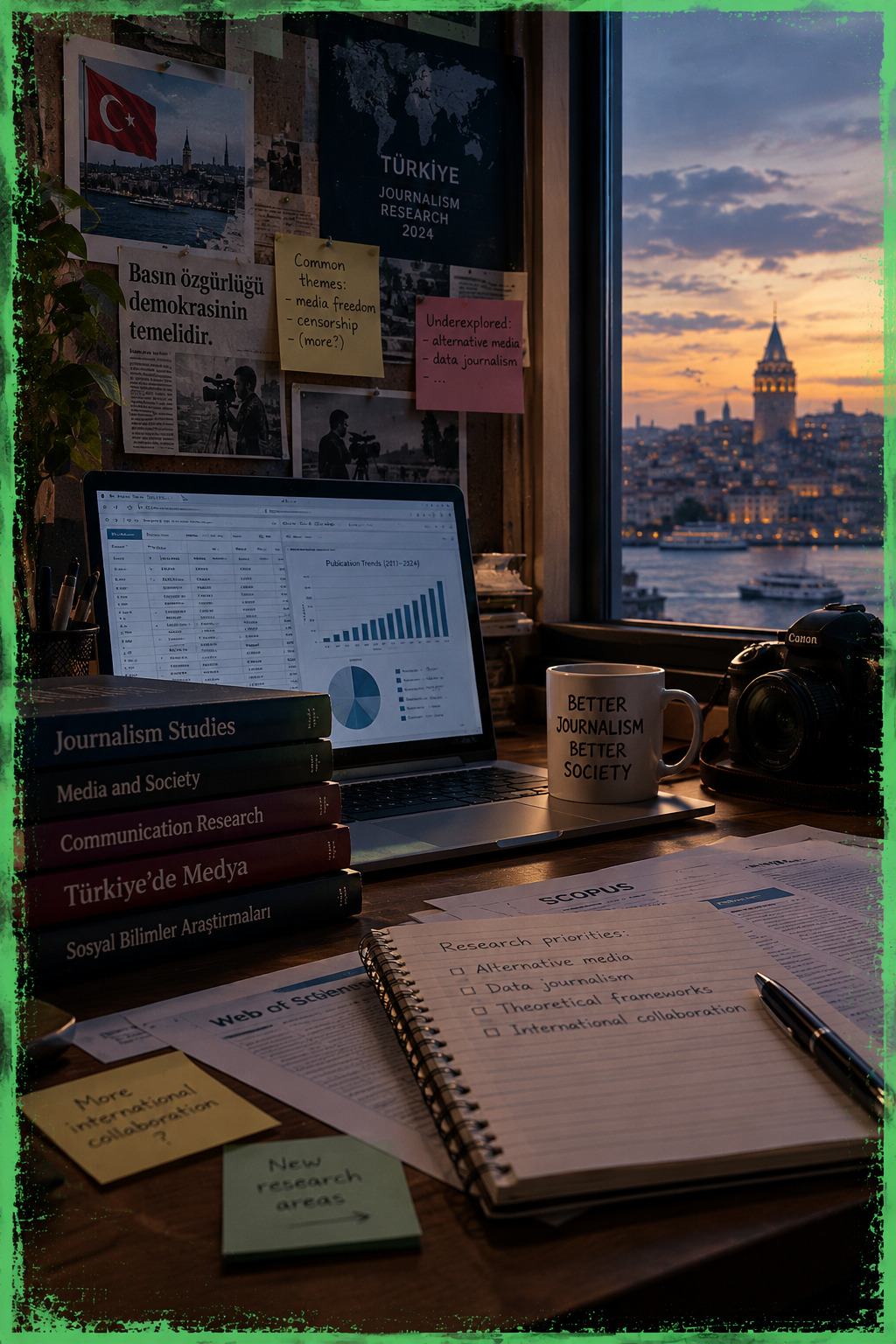
Journalism research in Türkiye has experienced significant growth, but it remained largely overlooked in international academic discourse until recently. Although early studies existed, relevant publications were not indexed in prominent databases such as Scopus and Web of Science until 2011, limiting the field’s international visibility.
This study aims to systematically analyze the development and trends within journalism research in Türkiye, tracing its evolution from the earliest publications through 2024.
Using a systematic literature review (SLR), the study screened 825 records retrieved from Scopus and Web of Science in accordance with the PRISMA 2020 framework and ultimately included 62 peer‑reviewed articles.
The review identifies a publication peak in 2021–2022 and a dominant focus on media freedom and censorship (37.10%), while topics such as alternative media and data journalism remain underexplored. Turkish scholars authored 56.5% of the publications, indicating strong local engagement but limited international collaboration. In addition, 64.5% of the studies did not articulate an explicit theoretical framework, pointing to a need for stronger conceptual grounding. Methodologically, the literature was predominantly qualitative (74%), with journalists constituting the most frequently studied group (21%).
The study calls for future research to address emerging areas of journalism, diversify methodological approaches, strengthen theoretical foundations, and foster greater international collaboration.
References
Akcakir, G., Jiang, Y., Luo, J., & Noh, S. (2023). Validating a Mixed-Method Approach for Multilingual News Framing Analysis: A case study of COVID-19. Computational Communication Research, 5(2), 1–70. https://doi.org/10.5117/CCR2023.2.11.AKCA
Akkus, A. (2023). The Parable of Copycat Headlines Under Erdogan Regime in Turkey. Cogent Social Sciences, 9(2), 2243723. https://doi.org/10.1080/23311886.2023.2243723
Akser, M., & Baybars-Hawks, B. (2012). Media and Democracy in Turkey: Toward a Model of Neoliberal Media Autocracy. Middle East Journal Of Culture And Communication, 5(3), 302–321. https://doi.org/10.1163/18739865-00503011
Alver, F., & Sarısakaloğlu, A. (2023). Communication Science in Türkiye: How Communication Research and Education Developed Over the Years. Publizistik, 68(1), 89–108. https://doi.org/10.1007/s11616-022-00766-4
Arcan, H. E. (2013). Ethnic Conflicts and the Role of the Media: The Case of Turkish Media. Mediterranean Journal of Social Sciences, 4(10), 338–346. https://doi.org/10.5901/mjss.2013.v4n10p338
Arik, E., & Akgün, H. (2019). Türk Sinemasında Gazeteci Kimliğinin Temsili [The Representation of the Journalist Identity in Turkish Cinema]. Türkiye İletişim Araştırmaları Dergisi, (34), 196‑220. https://doi.org/10.17829/turcom.664219 (In Turkish).
Arsan, E. (2013). Killing Me Softly with His Words: Censorship and Self-Censorship from the Perspective of Turkish Journalists. Turkish Studies, 14(3), 447–462. https://doi.org/10.1080/14683849.2013.833017
Aşık, O. (2017). The Fall of the Public and the Moral Contestation in the Journalistic Culture of Turkey. Middle East Journal of Culture and Communication, 10(1), 69–85. https://doi.org/10.1163/18739865-01001005
Atabaş, H., & Köse, M. (2024). Unraveling Türkiye Alums’ Role as Agents of Everyday Diplomacy. International Journal of Educational Research, 128, 102470. https://doi.org/10.1016/j.ijer.2024.102470
Ataman, B., Çoban, B., & Erkmen, Ö. (2020). A Review on the Safety of Journalists in Turkey: A Victims’ Rights Perspective. In S. Jamil (Ed.), Advances in Media, Entertainment, and the Arts (pp. 148‑171). IGI Global. https://doi.org/10.4018/978-1-7998-1298-2.ch009
Baris, K. (2020). Turkey’s Digital News Landscape: Polarization, Social Media, and Emerging Trends. EDAM. https://edam.org.tr/en/cyber-governance-digital-democracy/turkey-s-digital-news-landscape-polarization-social-media-and-emerging-trends
Boell, S. K., & Cecez-Kecmanovic, D. (2015). On being ‘Systematic’ in Literature Reviews in IS. Journal of Information Technology, 30(2), 161–173. https://doi.org/10.1057/jit.2014.26
Boomgaarden, H. G., & Schmitt-Beck, R. (2019). The Media and Political Behavior. In H. G. Boomgaarden & R. Schmitt-Beck, Oxford Research Encyclopedia of Politics. Oxford University Press. https://doi.org/10.1093/acrefore/9780190228637.013.621
Caled, D., & Silva, M. J. (2022). Digital Media and Misinformation: An Outlook on Multidisciplinary Strategies Against Manipulation. Journal of Computational Social Science, 5(1), 123–159. https://doi.org/10.1007/s42001-021-00118-8
Çelik, B. (2020). Screening for Erdoğanism: Television, Post-Truth and Political Fear. European Journal of Communication, 35(4), 339–354. https://doi.org/10.1177/0267323120903680
Chadegani, A. A., Salehi, H., Yunus, M. M., Farhadi, H., Fooladi, M., Farhadi, M., & Ebrahim, N. A. (2013). A Comparison between Two Main Academic Literature Collections: Web of Science and Scopus Databases. Asian Social Science, 9(5), p18. https://doi.org/10.5539/ass.v9n5p18
Çoban, B., & Ataman, B. (2017). The Gezi Resistance and Activist Citizen Reporters. Communications, 42(1), 1–22. https://doi.org/10.1515/commun-2017-0004
Cosentino, G., & Alikasifoglu, B. (2019). Políticas de la posverdad en el Próximo Oriente: Los estudios de caso de Siria y Turquía [Post-truth Politics in the Middle East: Case Studies of Syria and Turkey]. Artnodes, (24), 91-100. https://doi.org/10.7238/a.v0i24.3284 (In Spanish).
Coskuntuncel, A. (2018). Privatization of Governance, Delegated Censorship, and Hegemony in the Digital Era: The case of Turkey. Journalism Studies, 19(5), 690–708. https://doi.org/10.1080/1461670X.2016.1197045
Dudáš, M. (2024). Electoral Manipulation Strategies in Turkey During the Akp Rule. Trames. Journal of the Humanities and Social Sciences, 28(4), 331–350. https://doi.org/10.3176/tr.2024.4.02
Eko, L., & Hellmueller, L. (2020). One Meta-Media Event, Two Forms of Censorship: The Charlie Hebdo Affair in the United Kingdom and Turkey. Global Media and Communication, 16(1), 75–101. https://doi.org/10.1177/1742766519899118
Entman, R. M. (1993). Framing: Toward Clarification of a Fractured Paradigm. Journal of Communication, 43(4), 51–58. https://doi.org/10.1111/j.1460-2466.1993.tb01304.x
Entman, R. M. (2010). Media Framing Biases and Political Power: Explaining Slant in News of Campaign 2008. Journalism, 11(4), 389–408. https://doi.org/10.1177/1464884910367587
Erkmen, Ö. (2024). Data Journalism: A Systematic Literature Review. Journalism Studies, 25(1), 58–79. https://doi.org/10.1080/1461670X.2023.2289885
Europe – Central Asia: Türkiye. (2025). Rsf.Org. https://rsf.org/en/country-türkiye
Fiedler, A., & Frère, M.-S. (2018). Press Freedom in the African Great Lakes Region: A Comparative Study of Rwanda, Burundi, and the Democratic Republic of Congo. In H. M. Mabweazara (Ed.), Newsmaking Cultures in Africa (pp. 119–143). Palgrave Macmillan UK. https://doi.org/10.1057/978-1-137-54109-3_6
Fingerman, S. (2006). Web of Science and Scopus: Current features and Capabilities. Issues in Science and Technology Librarianship, (48). https://doi.org/10.29173/istl2081
Gürkan, H., Echazarreta-Soler, C., Sarpkaya, Ö., Sayıklı, E. D., Özbıyık, S. Ş., & Özgör, D. (2024). Exploring Gender and Homicide: Insights from Turkish Media Professionals of Generations X, Y, and Z. Romanian Journal of Communication and Public Relations, 26(1), 7–24. https://doi.org/10.21018/rjcpr.2024.1.535
Guzel, M., & Gonden, M. (2022). Journalism Education in Turkey in the Spiral of Neoliberal Policies and Technological Transformation: Problems, Pursuits, and Suggestions. Journal of Qualitative Research in Education, 22(31). https://doi.org/10.14689/enad.31.1610
Hallin, D. C., & Mancini, P. (2004). Comparing Media Systems: Three Models of Media and Politics. Cambridge University Press.
Hardy, J. (2014). Critical Political Economy of the Media: An Introduction (1st ed.). Routledge. https://doi.org/10.4324/9780203136225
Hatakka, N., & Herkman, J. (2022). Hegemonic Meanings of Populism: Populism as a Signifier in Legacy Dailies of Six Countries 2000–2018. Media, Culture & Society, 44(8), 1523–1540. https://doi.org/10.1177/01634437221104680
Hawks, B. B., & Smith, A. G. (2013). Publishing Leaked Information as News: Sabotage or Journalistic Success? Mediterranean Journal of Social Sciences, 4(10), 271–277. https://doi.org/10.5901/mjss.2013.v4n10p271
Iyigüngör, V. (2013). Political System Discussions in Turkish Media. Mediterranean Journal of Social Sciences, 4(10), 204–208. https://doi.org/10.5901/mjss.2013.v4n10p204
Kaya, R., & Çakmur, B. (2010). Politics and the Mass Media in Turkey. Turkish Studies, 11(4), 521–537. https://doi.org/10.1080/14683849.2010.540112
Kayali, N. (2024). Managing Uncertain Times in Turkey: Refugee Healthcare Research during a Global Pandemic. International Journal of Middle East Studies, 56(1), 151–156. https://doi.org/10.1017/S0020743824000242
Kızılkaya, E., & Ütücü, B. (2021). ‘The New Mainstream’ is Rising (and It Seeks Support). Free Turkey Journalists. https://freeturkeyjournalists.ipi.media/turkey-digital-media-report/
Kurban, D., & Sözeri, C. (2011). Does Media Policy Promote Media Freedom and Independence? The Case of Turkey (Case Study Report Nos. FP7-SSH-2009-A no. 244365). Mediadem.
Maharani, E. (2024). The Fourth Estate Unbound: Examining Press Law and Ethics in the Digital Age in Indonesia. Indonesia Media Law Review, 3(1). https://doi.org/10.15294/imrev.v3i1.78901
Maniou, T. A. (2023). The Dynamics of Influence on Press Freedom in Different Media Systems: A Comparative Study. Journalism Practice, 17(9), 1937–1961. https://doi.org/10.1080/17512786.2022.2030246
Maniou, T. A., & Papadopoulou, L. (2024). Editorial: Press Freedom, Journalism Practice, and Professionalization in Times of Uncertainty. Frontiers in Communication, 9, 1524823. https://doi.org/10.3389/fcomm.2024.1524823
Mansell, R. (2004). Political Economy, Power and New Media. New Media & Society, 6(1), 96–105. https://doi.org/10.1177/1461444804039910
Meho, L. I., & Rogers, Y. (2008). Citation Counting, Citation Ranking, and H ‐Index of Human‐Computer Interaction Researchers: A Comparison of Scopus and Web of Science. Journal of the American Society for Information Science and Technology, 59(11), 1711–1726. https://doi.org/10.1002/asi.20874
Mosco, V. (2009). The Political Economy of Communication: A Living Tradition. Media Asia, 36(3), 146‑155. https://doi.org/10.1080/23776277.2009.12224389
Mosco, V. (2016). The Political Economy of Journalism. In J. A. D. Lopes, N. do N. Nogueira, & J. L. Dourado (Eds.), Economía política do jornalismo. Tendências, perspectivas e desenvolvimento regional [The Political Economy of Journalism: Trends, Perspectives, and Regional Development] (pp. 19–42). Gráfica Universitária da UFPI. (In Portuguese).
Mulrow, C. D. (1994). Systematic Reviews: Rationale for Systematic Reviews. BMJ, 309(6954), 597–599. https://doi.org/10.1136/bmj.309.6954.597
Norris, M., & Oppenheim, C. (2007). Comparing Alternatives to the Web of Science for Coverage of the Social Sciences’ Literature. Journal of Informetrics, 1(2), 161–169. https://doi.org/10.1016/j.joi.2006.12.001
Orłowska, A., Mazur, Z., & Łaguna, M. (2017). Systematyczny Przegląd Literatury: Na Czym Polega I Czym Różni Się Od Innych Przeglądów? [Systematic Literature Review: What Is It, and How Does It Differ from Other Reviews?] Ogrody Nauk i Sztuk, (7), 350–363. https://doi.org/10.15503/onis2017.350.363 (In Polish).
Ozay, S., & Bayrakcı, S. (2022). Data Journalism in Turkey: Developing a Scale and Measuring Journalists’ Skills. İnsan Ve Toplum, 12(4), 74–98.
Özdemir, H. (2023). Freedom of Thought and Expression: Censorship on Media in Turkey. In M. Okyayuz, J. Mao, L. G. Mpedi, & P. Herrmann (Eds.), Human Rights in a Changing World (pp. 291–323). Springer Fachmedien Wiesbaden. https://doi.org/10.1007/978-3-658-39533-9_11
Öztunc, M., & Pierre, M.-H. (2021). Analysis of the Obstacles to the Freedom and Independence of the Media in the World and Turkey. Turkish Online Journal of Educational Technology - TOJET, 20(1), 1–9.
Öztürk, H. (2023). Türkiye’de Veri Gazeteciliği: Uluslararası Platformlarla Veri Görselleştirme Odaklı Bir Karşılaştırma [Data Journalism in Turkey: A Comparison Focused on Data Visualization with International Platforms]. Türkiye İletişim Araştırmaları Dergisi, (44), 127–147. https://doi.org/10.17829/turcom.1195919 (In Turkish).
Page, M. J., McKenzie, J. E., Bossuyt, P. M., Boutron, I., Hoffmann, T. C., Mulrow, C. D., Shamseer, L., Tetzlaff, J. M., Akl, E. A., Brennan, S. E., Chou, R., Glanville, J., Grimshaw, J. M., Hróbjartsson, A., Lalu, M. M., Li, T., Loder, E. W., Mayo-Wilson, E., McDonald, S., … Moher, D. (2021). The PRISMA 2020 Statement: An Updated Guideline for Reporting Systematic Reviews. BMJ, 372, n71. https://doi.org/10.1136/bmj.n71
Powell, K. R., & Peterson, S. R. (2017). Coverage and Quality: A Comparison of Web of Science and Scopus Databases for Reporting Faculty Nursing Publication Metrics. Nursing Outlook, 65(5), 572–578. https://doi.org/10.1016/j.outlook.2017.03.004
Priyadarsini, I. S., & Ravindran, V. (2023). Systematic Literature Review. Indian Journal of Continuing Nursing Education, 24(2), 114–118. https://doi.org/10.4103/ijcn.ijcn_1_24
Pukallus, S., Bradley, L., Clarke, S., & Harrison, J. (2020). From Repression to Oppression: News Journalism in Turkey 2013–2018. Media, Culture & Society, 42(7–8), 1443–1460. https://doi.org/10.1177/0163443720916407
Richeri, G. (2011). The Media amid Enterprises, the Public, and the State: New Challenges for Research. In J. Wasko, G. Murdock, & H. Sousa (Eds.), The Handbook of Political Economy of Communications (1st ed., pp. 127–139). Wiley. https://doi.org/10.1002/9781444395402.ch6
Riesenberg, L. A., & Justice, E. M. (2014). Conducting a Successful Systematic Review of the Literature, Part 1. Nursing, 44(4), 13–17. https://doi.org/10.1097/01.NURSE.0000444728.68018.ac
Samiee, S., & Athanassiou, N. (1998). International Strategy Research. Journal of Business Research, 43(2), 79–96. https://doi.org/10.1016/S0148-2963(97)00184-7
Sari, E. (2021). Popüler Basında Kovid-19 Haberleri: Yeni Tip Koronavirüs Eski Tip Banal Milliyetçilik [COVID-19 News in the Popular Press: The Novel Coronavirus vs. Old-Fashioned, Trite Nationalism]. İlef Dergisi, 8(1), 63-108. https://doi.org/10.24955/ilef.798007 (In Turkish).
Sen, A. F. (2017). Alternative Journalism Education in Turkey: A Case Study of the ‘From School to Newsroom’ (OHO) Program. Palgrave Communications, 3(1), 17015. https://doi.org/10.1057/palcomms.2017.15
Simon, J. (2014). The New Censorship: Inside the Global Battle for Media Freedom. Columbia University Press. https://doi.org/10.7312/simo16064
Souissi, N., & Tikito, I. (2019). Meta-analysis of Systematic Literature Review Methods. International Journal of Modern Education and Computer Science, 11(2), 17–25. https://doi.org/10.5815/ijmecs.2019.02.03
Sözeri, C. (2013). The political economy of the media and its impact on freedom of expression in Turkey. In C. Rodríguez, A. Ávalos, H. Yılmaz, & A. I. Planet (Eds.), Turkey’s Democratization Process (pp. 391–404). Taylor and Francis.
Sue, S. (1999). Science, Ethnicity, and Bias: Where Have We Gone Wrong? American Psychologist, 54(12), 1070–1077. https://doi.org/10.1037/0003-066X.54.12.1070
Sümer, B., & Taş, O. (2020). The Regulation of Television Content in Turkey: From State Monopoly to Commercial Broadcasting and Beyond. In Y. Kaptan & E. Algan (Eds.), Television in Turkey (pp. 27–46). Springer International Publishing. https://doi.org/10.1007/978-3-030-46051-8_2
Syahriar, I., Bazarah, J., Khairunnisah, & P, D. P. H. (2024). New Media and Their Implications for the Press Law. Revista de Gestão Social e Ambiental, 18(6), e06297. https://doi.org/10.24857/rgsa.v18n6-112
Tokgöz, O. (2003). Türkiye’de İletişim Eğitimi: Elli Yıllık Bir Geçmişin Değerlendirilmesi [Communication Education in Turkey: An Assessment of Fifty Years of History]. Kültür ve İletişim, 6(1), 9-32. (In Turkish).
Topkev, A. (2025). A democratic approach to religion news: Newspaper coverage of Christianity and Islam in the UK and Turkey. The Communication Review, 28(2), 131–169. https://doi.org/10.1080/10714421.2024.2424060
Trattner, C., Jannach, D., Motta, E., Costera Meijer, I., Diakopoulos, N., Elahi, M., Opdahl, A. L., Tessem, B., Borch, N., Fjeld, M., Øvrelid, L., De Smedt, K., & Moe, H. (2022). Responsible Media Technology and AI: Challenges and Research Directions. AI and Ethics, 2(4), 585–594. https://doi.org/10.1007/s43681-021-00126-4
Uzun, R. (2007). Türkiye’de gazetecilik eğitimi [Journalism Education in Turkey]. İletişim Kuram ve Araştırma Dergisi, 25(1), 245–252. (In Turkish).
Van Dijk, T. A. (2017). Discourse and Power. Red Globe Press.
Werz, M., & Hoffman, M. (2013). Freedom of the Press and Expression in Turkey. The Center for American Progress. https://www.americanprogress.org/article/freedom-of-the-press-and-expression-in-turkey/
Yanardağoğlu, E. (2021). The Transformation of the Media System in Turkey: Citizenship, Communication, and Convergence. Springer International Publishing. https://doi.org/10.1007/978-3-030-83102-8
Yesil, B. (2014). Press Censorship in Turkey: Networks of State Power, Commercial Pressures, and Self-Censorship: Press Censorship in Turkey. Communication, Culture & Critique, 7(2), 154–173. https://doi.org/10.1111/cccr.12049
Yilmaz Altuntas, E., & Öney Doğanyiğit, S. (2021). Social Determinants of Autism Spectrum Disorder in the Print Media News: A Qualitative Framing Analysis of Coverage in National Newspapers in Turkey. Cogent Social Sciences, 7(1), 1947607. https://doi.org/10.1080/23311886.2021.1947607
Zhu, J., & Liu, W. (2020). A Tale of Two Databases: The Use of Web of Science and Scopus in Academic Papers. Scientometrics, 123(1), 321–335. https://doi.org/10.1007/s11192-020-03387-8

This work is licensed under a Creative Commons Attribution 4.0 International License.
Copyright (c) 2026 Fathul Qorib, Mert Gürer