
Ключевые слова
цифровая социальность
символическое производство
нейросетевая агентность
мифологизация нейросетей
алгоритмические системы
институциональная интеграция
цифровые медиа
философия технологий
искусственный интеллект
Как цитировать
Аннотация
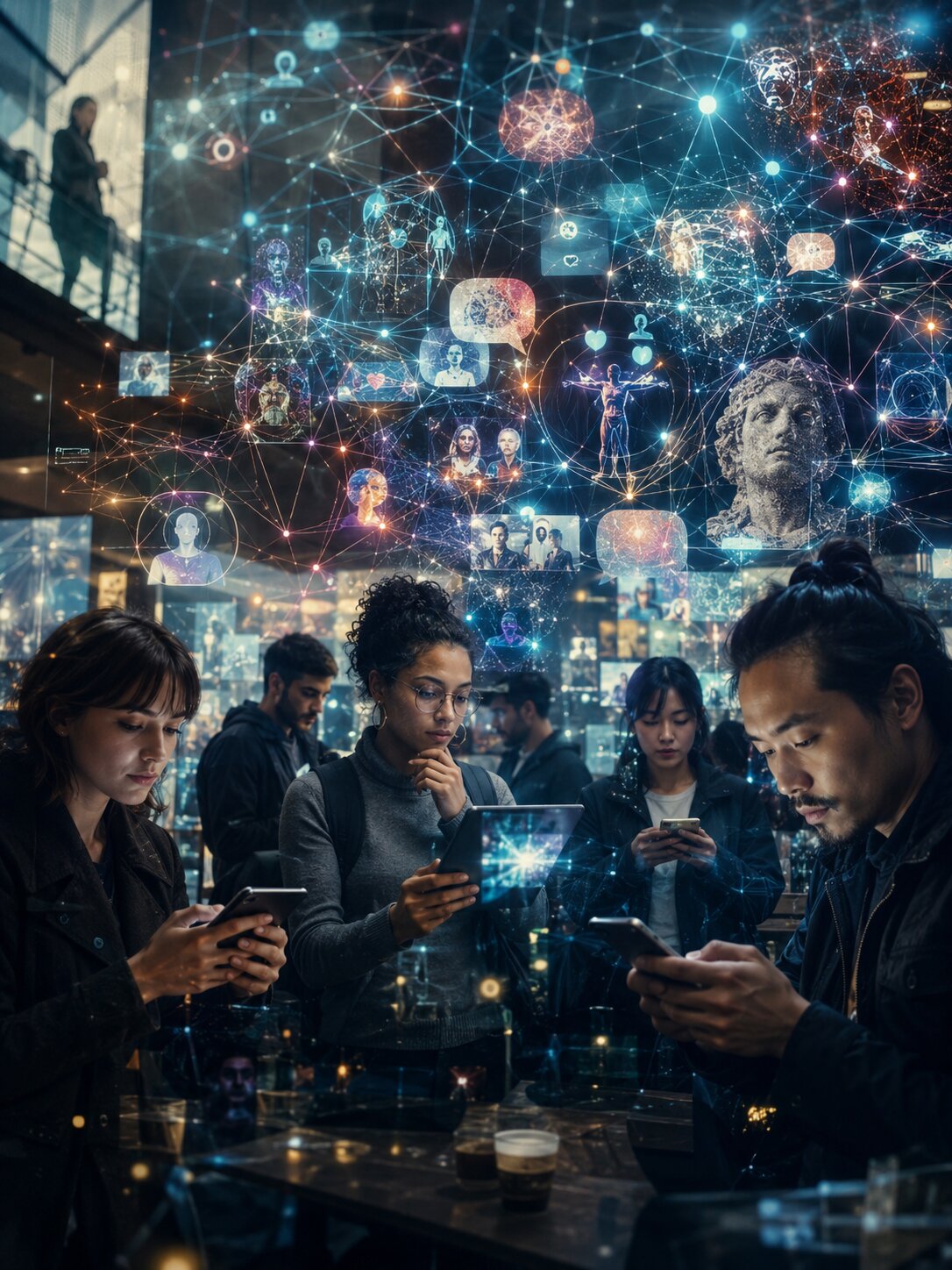
В статье рассматривается проблема трансформации статуса нейросетевых технологий в условиях цифровой социальности. Нейросети перестают быть просто инструментами обработки данных, а становятся участниками символического производства. Особое внимание уделяется противоречию между функциональной эффективностью нейросетей и отсутствием у них моральной субъектности, а также роли мифологизации в конструировании их как квазисубъектов. Показано, что включение нейросетей в социальные практики сопровождается изменением границ авторства, ответственности и социального действия. Цель исследования заключается в социально-философском осмыслении процессов социализации нейросетей, их агентности и места в структуре современной социальной онтологии. В результате установлено, что нейросети формируют новый социальный репертуар и включаются в институциональные практики как функционально автономные агенты, перераспределяя когнитивные, коммуникативные и экспертные роли. Выделены ключевые механизмы их социализации, включая дискурсивную мифологизацию и институциональную интеграцию, а также предложена типология сценариев развития нейросетевой социальности. Сделан вывод о необходимости пересмотра классических представлений о субъектности и ответственности в условиях формирования гибридной социальности. Статья рассчитана на исследователей в области социальной философии, медиаисследований и философии технологий, а также на специалистов, изучающих цифровую трансформацию общества.
Библиографические ссылки
Alekseeva, E. A. (2023). Computational Epistemology Projects. Filosofija nauki i tehniki / Philosophy of Science and Technology, 28(2), 88–101. https://doi.org/10.21146/2413-9084-2023-28-2-88-101 (In Russian).
Aliev, R. T. (2025a). Algorithmic Schizophrenia: Metasimulatory Transformation of Reality in the Digital Age. Philosophical Literary Journal Logos, 35(4), 229–250. https://doi.org/10.17323/0869-5377-2025-4-229-250 (In Russian).
Aliev, R. T. (2025b). Metasimulacrum and AI Simulation: Human, Media, Interfaces. Chelover, 36(1), 102‑120. https://doi.org/10.31857/S0236200725010076 (In Russian).
Aliev, R. T. (2025c). Post-Symbolic Coloniality: The Metasimulacrum of Otherness in Digital Culture. Galactica Media: Journal of Media Studies, 7(2), 166–186. https://doi.org/10.46539/gmd.v7i2.649
Aliev, R. T. (2026). The Faceless Interface: Digital Empathy, Care, and the Other within the Logic of the Metasimulacrum. International Journal of Philosophical Studies, 1–19. https://doi.org/10.1080/09672559.2026.2625457
Baturina, I. V. (2023). Megatrends and Mythologems of Artificial Intelligence Topics in Western Scientific Discourse. Izvestiya of Saratov University. Philosophy. Psychology. Pedagogy, 24(1), 14–18. https://doi.org/10.18500/1819-7671-2024-24-1-14-18 (In Russian).
Berners-Lee, T. (1989). Information management: A proposal. CERN. https://www.w3.org/History/1989/proposal.html
Bostrom, N. (2014). Superintelligence: Paths, Dangers, Strategies. OUP Oxford.
Boyd, D. M., & Ellison, N. B. (2007). Social Network Sites: Definition, History, and Scholarship. Journal of Computer-Mediated Communication, 13(1), 210–230. https://doi.org/10.1111/j.1083-6101.2007.00393.x
Brown, T., Mann, B., Ryder, N., Subbiah, M., Kaplan, J. D., Dhariwal, P., Neelakantan, A., Shyam, P., Sastry, G., Askell, A., Agarwal, S., Herbert-Voss, A., Krueger, G., Henighan, T., Child, R., Ramesh, A., Ziegler, D., Wu, J., Winter, C., … Amodei, D. (2020). Language Models are Few-Shot Learners. Advances in Neural Information Processing Systems, 33, 1877–1901.
Couldry, N., & Mejias, U. A. (2019). The Costs of Connection: How Data Is Colonizing Human Life and Appropriating It for Capitalism. Stanford University Press. https://doi.org/10.1515/9781503609754
Crawford, K. (2021). The Atlas of AI: Power, Politics, and the Planetary Costs of Artificial Intelligence. Yale University Press. https://doi.org/10.12987/9780300252392
Dijck, J. van. (2013). The Culture of Connectivity: A Critical History of Social Media. OUP USA.
Dydrov, A. A. (2023a). Artificial Intelligence: Mythologies of Western Scientific Content. Socium i vlast' [Society and Power], (1), 16–25. https://doi.org/10.22394/1996-0522-2023-1-16-25 (In Russian).
Dydrov, A. A. (2023b). Artificial Intelligence: Mythologies of Social Studies. Izvestiya of Saratov University. Philosophy. Psychology. Pedagogy, 23(3), 262–266. https://doi.org/10.18500/1819-7671-2023-23-3-262-266 (In Russian).
Dydrov, A. A., & Varlamova, A. A. (2025). Philosophy of the Face and Neural Network Agents. Galactica Media: Journal of Media Studies, 7(2), 128–145. https://doi.org/10.46539/gmd.v7i2.647 (In Russian).
Fisher, E. (2022). Algorithms and Subjectivity: The Subversion of Critical Knowledge. Routledge, Taylor & Francis Group. https://doi.org/10.4324/9781003196563
Floridi, L. (2023). The Ethics of Artificial Intelligence: Principles, Challenges, and Opportunities. Oxford University Press. https://doi.org/10.1093/oso/9780198883098.001.0001
Floridi, L., & Cowls, J. (2019). A Unified Framework of Five Principles for AI in Society. Harvard Data Science Review. https://doi.org/10.1162/99608f92.8cd550d1
Gafarov, F. M., & Galimyanov, A. F. (2018). Artificial Neural Networks and Their Applications. Kazan University Press. (In Russian).
Goodfellow, I. J., Pouget-Abadie, J., Mirza, M., Xu, B., Warde-Farley, D., Ozair, S., Courville, A., & Bengio, Y. (2014). Generative Adversarial Nets. Advances in Neural Information Processing Systems, 27. https://proceedings.neurips.cc/paper/2014/hash/f033ed80deb0234979a61f95710dbe25-Abstract.html
Harari, Y. N. (2016). Homo Deus: A Brief History of Tomorrow. Harvill Secker. https://doi.org/10.17104/9783406704024
Hebb, D. O. (1949). The Organization of Behavior: A Neuropsychological Theory. Wiley.
Hochreiter, S., & Schmidhuber, J. (1997). Long Short-Term Memory. Neural Computation, 9(8), 1735‑1780. https://doi.org/10.1162/neco.1997.9.8.1735
Ivanov, D. V. (2023). Critical Theory of Digitalization: Algorithmic Rationality Domination and Authenticity Revolt. Zhurnal sotsiologii i sotsialnoy antropologii (The Journal of Sociology and Social Anthropology), 26(3), 7–35. https://doi.org/10.31119/jssa.2023.26.3.1 (In Russian).
Latour, B. (2005). Reassembling the Social: An Introduction to Actor-Network-Theory. OUP Oxford. https://doi.org/10.1093/oso/9780199256044.001.0001
Lecun, Y., Bottou, L., Bengio, Y., & Haffner, P. (1998). Gradient-based learning applied to document recognition. Proceedings of the IEEE, 86(11), 2278–2324. https://doi.org/10.1109/5.726791
Maalsen, S. (2023). Algorithmic Epistemologies and Methodologies: Algorithmic Harm, Algorithmic Care and Situated Algorithmic Knowledges. Progress in Human Geography, 47(2), 197–214. https://doi.org/10.1177/03091325221149439
Makhamatov, T. M. (2019). Philosophy of Artificial Intelligence. Humanities and Social Sciences. Bulletin of the Financial University, 9(4), 52–56. https://doi.org/10.26794/2226-7867-2019-9-4-52-56 (In Russian).
McCulloch, W. S., & Pitts, W. (1943). A logical calculus of the ideas immanent in nervous activity. The Bulletin of Mathematical Biophysics, 5(4), 115–133. https://doi.org/10.1007/BF02478259
Minsky, M. L., & Papert, S. (1969). Perceptrons: An Introduction to Computational Geometry. MIT Press.
Pennet, R. V. (2025). Algorithmic Rationality: for Evil or for Good? Sotsiologicheskie issledovaniya [Sociological Studies], (10), 31–38. https://doi.org/10.31857/S0132162525100035 (In Russian).
Rosenblatt, F. (1958). The Perceptron: A Probabilistic Model for Information Storage and Organization in the Brain. Psychological Review, 65(6), 386–408. https://doi.org/10.1037/h0042519
Rumelhart, D. E., Hinton, G. E., & Williams, R. J. (1986). Learning representations by back-propagating errors. Nature, 323(6088), 533–536. https://doi.org/10.1038/323533a0
Russell, S., & Norvig, P. (2021). Artificial Intelligence: A Modern Approach, Global Edition. Pearson Higher Ed.
Srnicek, N. (2019). Platform Capitalism. HSE Publishing House. https://doi.org/10.17323/978-5-7598-1786-4 (In Russian).
Stepin, V. S. (2013). Types of Scientific Rationality and the Synergetic Paradigm. Complexity. Mind. Postnonclassics, (4), 45–59. (In Russian).
Tegmark, M. (2017). Life 3.0: Being Human in the Age of Artificial Intelligence. Knopf Doubleday Publishing Group.
Tikhonova, S. V. (2016). Social Networks: Problems of Internet Socialization. Polis. Political Studies, (3), 138–152. https://doi.org/10.17976/jpps/2016.03.11 (In Russian).
Tikhonova, S. V., & Shipovalova, L. V. (2025). Mediascience as an Actor of a New Social Ontology. Philosophy Journal of the Higher School of Economics, 9(3), 177–199. https://doi.org/10.17323/2587-8719-2025-3-177-199 (In Russian).
Vaswani, A., Shazeer, N., Parmar, N., Uszkoreit, J., Jones, L., Gomez, A. N., Kaiser, Ł. ukasz, & Polosukhin, I. (2017). Attention is All you Need. Advances in Neural Information Processing Systems, 30. https://proceedings.neurips.cc/paper/2017/hash/3f5ee243547dee91fbd053c1c4a845aa-Abstract.html
Wooldridge, M. (2009). An Introduction to MultiAgent Systems. John Wiley & Sons.
Zuboff, S. (2019). The Age of Surveillance Capitalism: The Fight for a Human Future at the New Frontier of Power. Profile Books.

Это произведение доступно по лицензии Creative Commons «Attribution» («Атрибуция») 4.0 Всемирная.
Copyright (c) 2026 Лучников Антон Викторович, Мельничук Дмитрий Вадимович