
Keywords
Neuromarketing
Affective Technologies
Pupillometry
4E Cognition
Enactivism
Phenomenology of Cinema
Cinematic Affect
Biometric Data
Performative Viewing
How to Cite
Abstract
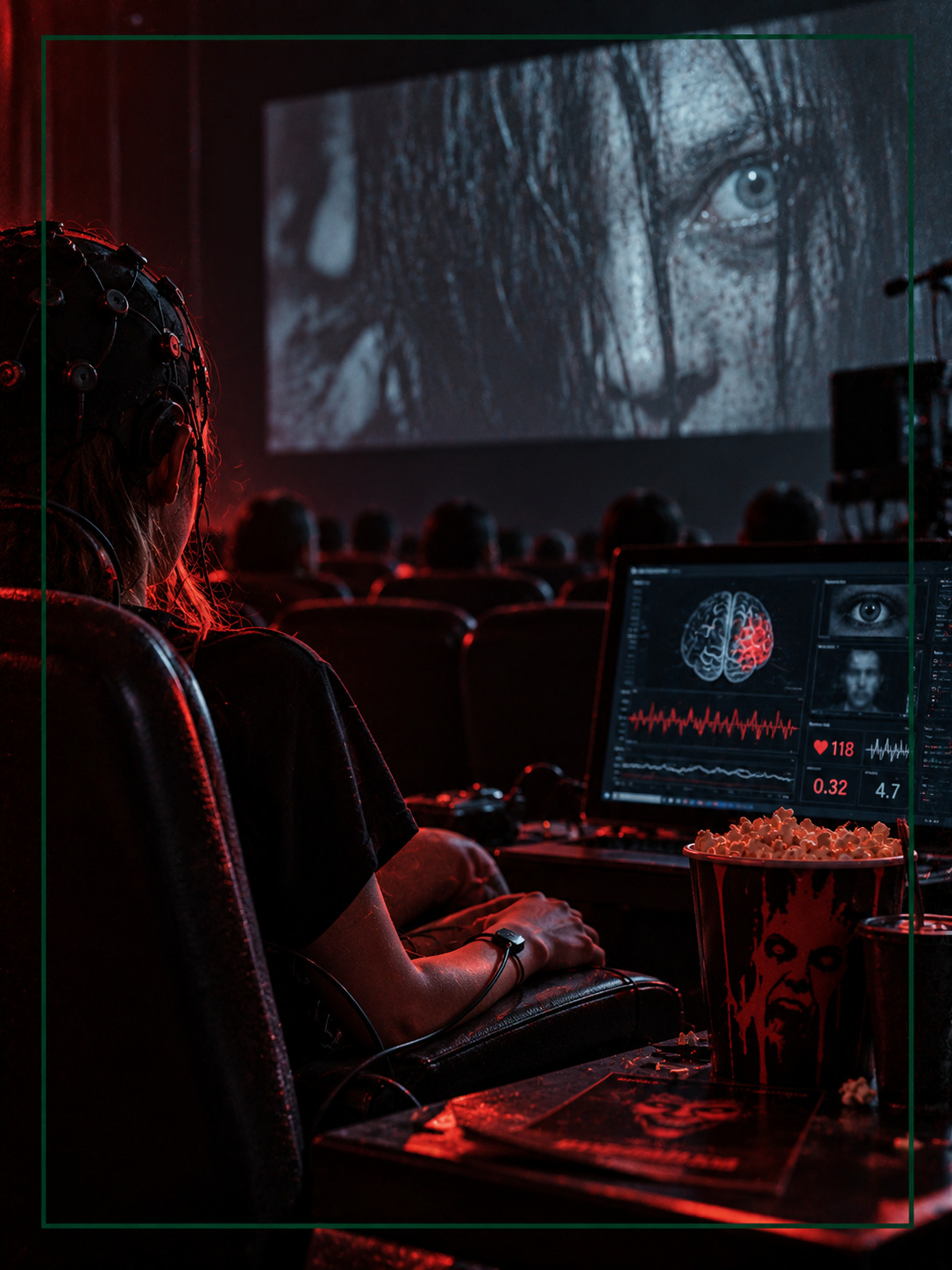
This article explores the transformation of horror film marketing between 2023 and 2025 amid a shift from traditional visual representations of fear to the embodied elicitation of fear and the measurement of audience responses. Contemporary horror campaigns increasingly employ neuromarketing and performative practices that position the audience not only as the target of advertising but also as a source of biometric data, thereby making physiological responses an integral part of media production. The limited theoretical engagement with these practices in cultural studies and media philosophy calls for a systematic analysis. The aim of the article is to identify the cultural, phenomenological, and ethical and legal foundations of horror film neuromarketing through an analysis of the promotional campaigns for “Evil Dead Rise” (2023), “Smile 2” (2024), “Together” (2025), and “Long Walk” (2025).
The study shows that contemporary horror marketing practices reflect a broadening of promotional strategies : alongside on-screen representations of fear, these strategies increasingly engage the audience’s body. Technologies such as GSR, EEG, eye-tracking, pupillometry, facial expression recognition, and immersive performative formats allow affective and physiological responses to be recorded, thereby transforming them into valuable marketing tools and quantifiable media resources. The study concludes that these practices heighten cinematic immersion while also creating risks of manipulation, desubjectivation, and breaches of standards governing the processing of biometric data. The article is intended for film and media researchers, scholars in cultural studies, philosophers, marketing professionals, and specialists in the legal regulation of digital technologies.
References
Carroll, N. (1990). The Philosophy of Horror, Or, Paradoxes of the Heart. Routledge.
Crawford, K. (2021). Atlas of AI: Power, Politics, and the Planetary Costs of Artificial Intelligence. Yale University Press. https://doi.org/10.12987/9780300252392
Critchley, H. D., Wiens, S., Rotshtein, P., Öhman, A., & Dolan, R. J. (2004). Neural Systems Supporting Interoceptive Awareness. Nature Neuroscience, 7(2), 189–195. https://doi.org/10.1038/nn1176
Gallagher, S. (2017). Enactivist Interventions (Vol. 1). Oxford University Press. https://doi.org/10.1093/oso/9780198794325.001.0001
Hasson, U., Landesman, O., Knappmeyer, B., Vallines, I., Rubin, N., & Heeger, D. J. (2008). Neurocinematics: The Neuroscience of Film. Projections, 2(1), 1–26. https://doi.org/10.3167/proj.2008.020102
Laeng, B., Sirois, S., & Gredebäck, G. (2012). Pupillometry: A Window to the Preconscious? Perspectives on Psychological Science, 7(1), 18–27. https://doi.org/10.1177/1745691611427305
Marks, L. U. (2000). The Skin of the Film: Intercultural Cinema, Embodiment, and the Senses. Duke University Press. https://doi.org/10.1215/9780822381372
Mathôt, S. (2018). Pupillometry: Psychology, Physiology, and Function. Journal of Cognition, 1(1), 16. https://doi.org/10.5334/joc.18
Merleau-Ponty, M. (1999). Phenomenology of Perception. Nauka. (In Russian).
Ndalianis, A. (2012). The Horror Sensorium: Media and the Senses. McFarland.
Newen, A., De Bruin, L., & Gallagher, S. (2018). Introduction. In A. Newen, L. de Bruin, & S. Gallagher (Eds.), The Oxford Handbook of 4E Cognition (pp. 3–19). OUP Oxford. https://doi.org/10.1093/oxfordhb/9780198735410.001.0001
Noë, A. (2004). Action in Perception. MIT Press.
Phelps, E. A., & LeDoux, J. E. (2005). Contributions of the Amygdala to Emotion Processing: From Animal Models to Human Behavior. Neuron, 48(2), 175–187. https://doi.org/10.1016/j.neuron.2005.09.025
Picard, R. W. (1997). Affective Computing. The MIT Press. https://doi.org/10.7551/mitpress/1140.001.0001
Shaviro, S. (2010). Post Cinematic Affect. Zer0 Books.
Sobchack, V. (2004). Carnal Thoughts: Embodiment and Moving Image Culture. University of California Press. https://doi.org/10.1525/9780520937826
Varela, F. J., Thompson, E., & Rosch, E. (2023). The Embodied Mind: Cognitive Science and Human Experience. Fond “Sokhranim Tibet”. (In Russian).

This work is licensed under a Creative Commons Attribution 4.0 International License.
Copyright (c) 2026 Daria D. Alieva